 Free
FreeEmployee Journey Map for OpenAI Teams
Map every moment that matters, together, without the sticky notes.
Top brands trust Pyn


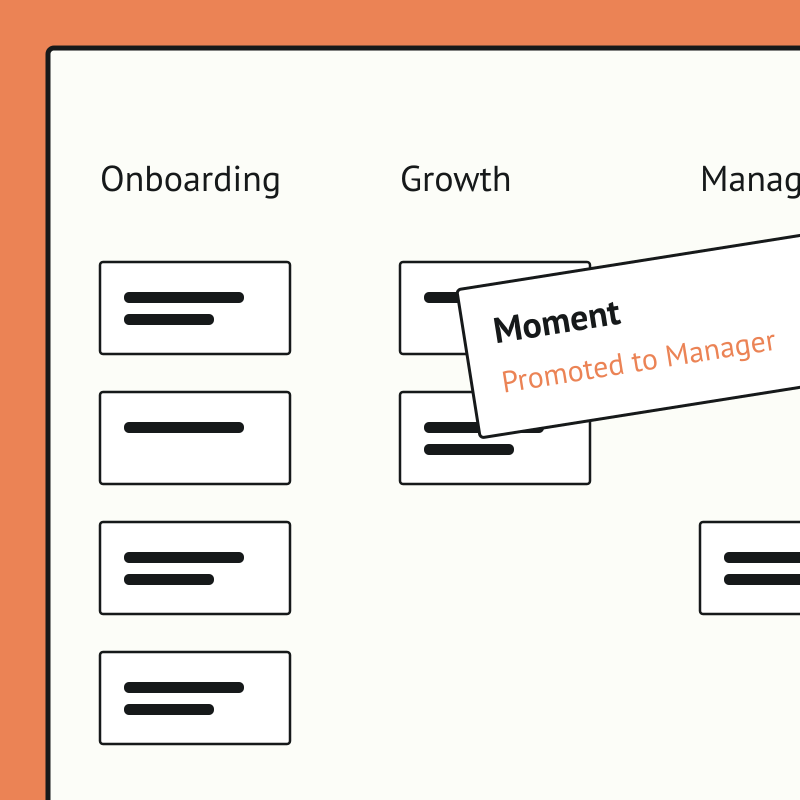
Pyn's free Employee Journey Designer turns a daunting, whiteboard-and-sticky-notes exercise into a fast, collaborative map of every moment that matters, from before day one to after the last day. Teams start from hundreds of ready-made moments and touchpoints rather than a blank page.
Employee Journey Map is free, and it runs standalone for now — you can start using it today by uploading your own people data. If there's enough interest we'll build a direct OpenAI integration so it syncs automatically. Book a demo and we can cover it.
The payoff is clarity and alignment. People teams can see the whole experience, prioritize what to improve, assign owners, and get cross-functional buy-in, so effort goes where it lifts the experience most.
The context lives in Pyn. GPT does the thinking.
Every employee in Pyn comes with context — their role, their team, their location, and exactly where they sit in their journey today. Connect OpenAI, and GPT models can put that context to work through AI-agent skills that take real action:
- Write tailored messages - grounded in the person’s situation, not a one-size-fits-all template.
- Distil the signal - condense survey answers, poll results, or free-text feedback into something you can act on.
- Field employee questions - answered against the context Pyn already holds about the person asking.
- Recommend what to do next - the right nudge, reply, or Flow step for the moment.
Pyn owns the context. GPT is the intelligence that runs on it.
Why connect Pyn and OpenAI?
Ground every response in who the employee is. On its own, a model is guessing. Pyn hands GPT the specifics — this is a returning parent, six months tenured, on the London team — so drafts, summaries, and recommendations reflect the real person rather than a stereotype.
You stay the decision-maker. GPT-powered skills produce drafts and suggestions; the call is always yours. Review, tweak, approve — the AI carries the busywork, you keep control of what actually ships.
Skip the blank page. Ask GPT to draft copy shaped by department, location, and moment, then refine it. Pyn handles delivery through Slack, Teams, or email, sent from the sender that makes sense.
Useful across every moment. Whether it’s onboarding, a promotion, a return from leave, or offboarding, context-aware skills can lend a hand anywhere in the employee journey where a faster, sharper action helps.
FAQs
What does the OpenAI integration do?
It links OpenAI’s GPT models to Pyn’s employee context layer, letting AI-agent skills draft messages, summarize responses, answer questions, and suggest next actions using the employee data Pyn already maintains.
How much of my data does GPT get?
Only what a specific skill requires. Pyn shares the context relevant to the task — never a bulk export of your people data.
Will AI messages send on their own?
No, unless you choose that. GPT-powered skills draft and recommend by default, and you sign off before anything reaches an employee.
Can it tailor content by department, role, or location?
Yes. Running on Pyn’s context layer means GPT draws on the same fields Pyn uses to personalize and target messages.
How are messages delivered?
Through the channels your people already use — Slack, Microsoft Teams, or email.
Does Pyn also work with Anthropic’s Claude?
Yes. If you prefer Claude, the same context-aware AI skills are available through Pyn’s Anthropic integration.
Is my data secure?
Pyn is SOC 2 compliant. We only pass the context a skill needs to complete its task.
Your HR stack, with superpowers.
Pick the tools you need. Launch in a day. Cancel anytime.